Do Desk Plants Improve Focus? What Research Says
What studies show about plants, attention and productivity at work, where the evidence is weak and how to set up a desk to get the real benefit.
By Gustavo Girard. Updated . 6 min read.
This guide contains affiliate links. If you buy through one, GrowPlants may earn a commission at no extra cost to you. Read the Disclosure
The evidence suggests desk plants help a little, and for a different reason than most people assume. Studies link plants in view to better attention, mood and self reported productivity. The popular claim that they clean the air does not hold up at home or in an office. The benefit comes from looking at them, so placement matters more than quantity.
Do Plants Improve Focus?#
Plants in a workspace are associated with modest gains in attention and productivity. The most cited evidence is three field experiments by Nieuwenhuis and colleagues, published in 2014 in the Journal of Experimental Psychology: Applied. In offices in the Netherlands and the UK, floors enriched with plants showed better perceived air quality, concentration and satisfaction than bare "lean" floors, plus better results on objective productivity measures.
The University of Exeter, one of the institutions behind the work, summarized the result as a productivity gain of about 15 percent. Read that number with care. Concentration and air quality were what workers said they felt. Nobody measured them with an instrument. The work is strong because it took place in real offices, and two of the three experiments ran over weeks and months. It is still one research group's work, and a plant is a reasonable improvement to a desk, not a fix for a workload.
What Did the Lab Studies Find?#
Lab studies of plants and attention find small, short term effects. In a 2011 study by Raanaas and colleagues, 34 participants worked in an office with or without indoor plants. The plant group's attention scores rose between the first and second tests while the other group's did not. After a five minute break, neither group improved further. The sample was small, and the participants were students rather than office workers.
A 2015 study by Lee and colleagues at the University of Melbourne tested 150 students on a dull attention task. Partway through, each one looked for 40 seconds at a picture of either a flowering green roof or a bare concrete roof. The green roof group made significantly fewer errors afterward. Forty seconds was enough. Still, it was a picture of a roof, not a plant on a desk.
Why Would a Plant Help You Concentrate?#
The leading explanation is attention restoration theory, developed by psychologists Rachel and Stephen Kaplan and laid out in a 1995 paper by Stephen Kaplan. Focused work drains directed attention, the effortful kind you use to ignore distractions. Natural elements hold your gaze without effort, which lets directed attention recover. A brief look at something green between tasks works like a small break, even when you stay in your chair.
The green roof study was built to test that idea, and its result fits it. It also explains why placement matters. A plant behind you does nothing for you. You never look at it.
Do Desk Plants Clean the Air?#
Desk plants do not clean indoor air in any amount that matters. The idea traces back to a 1989 NASA study that, as Drexel University describes, tested plants in sealed lab chambers. A review by Cummings and Waring in the Journal of Exposure Science and Environmental Epidemiology found a building would need 10 to 1,000 plants per square meter of floor to match what normal air exchange already does.
The review pooled 196 results from 12 chamber studies. The median plant cleaned the equivalent of 0.023 cubic meters of air per hour, about 23 liters. A sealed chamber over several days is nothing like a ventilated room. Want cleaner air? Open a window. Keep plants for the other reasons.
How Should You Set Up Plants to Get the Benefit?#
Set up desk plants so you see them without effort, and so they stay healthy in the light you have. Put one plant at the edge of your field of view, beside or just behind the screen. Choose a species that suits the light at your desk rather than the one you like best, because a plant losing leaves in a dark corner is a small, daily source of stress, not relief.
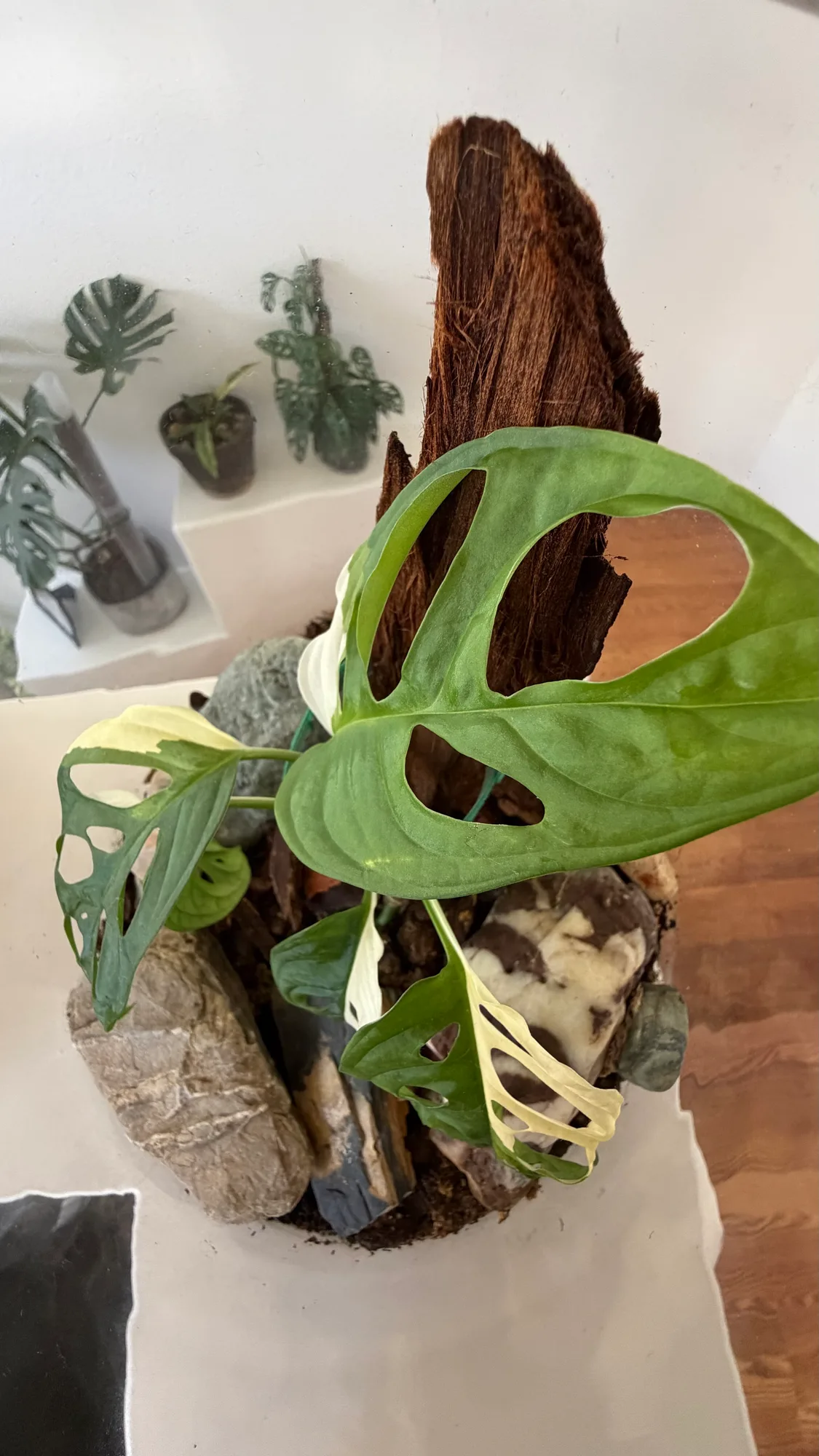
Save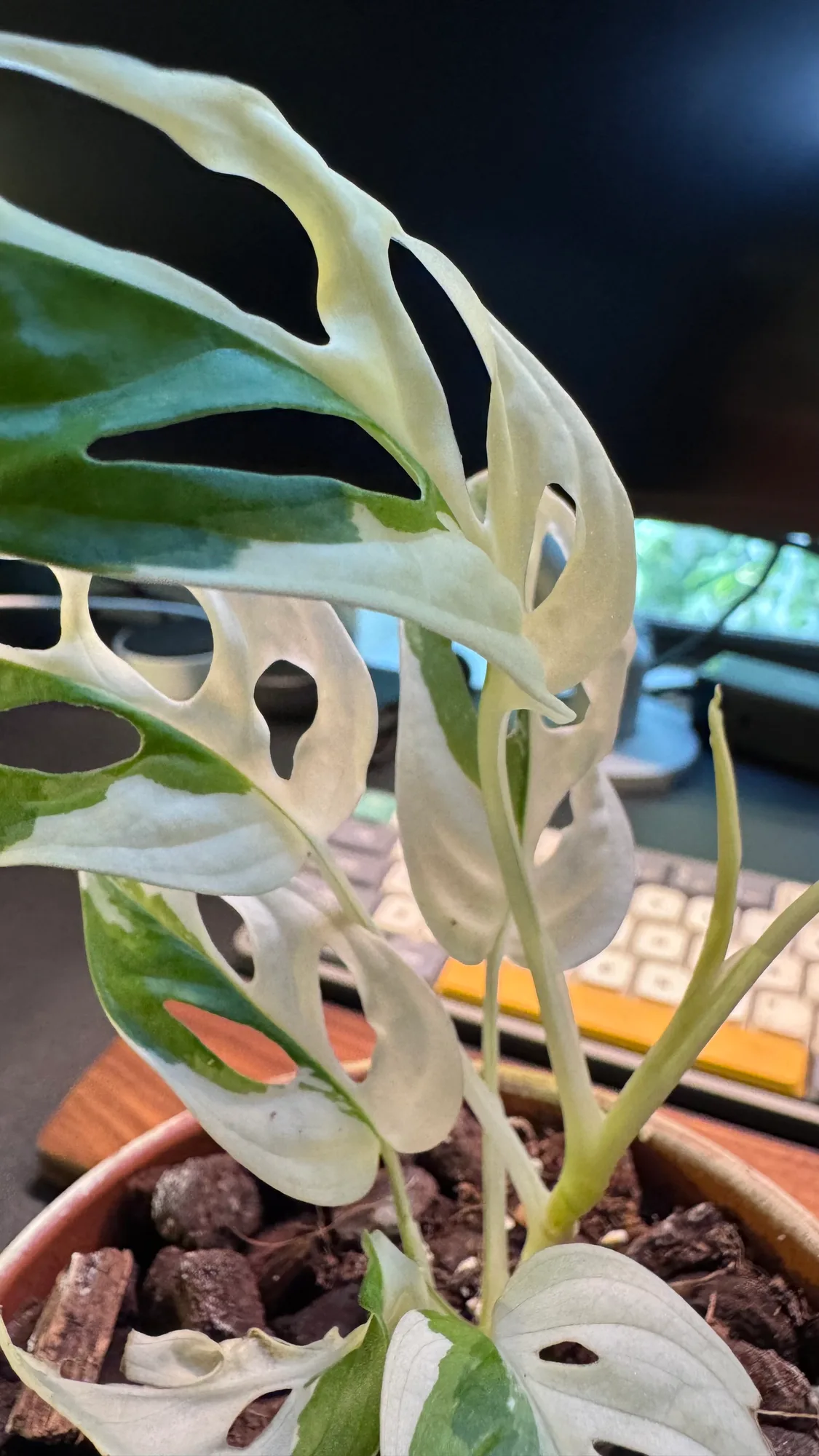 A variegated Monstera adansonii beside the keyboard, inside the field of view.
- Put one plant within your field of view, beside or just behind the screen.
- Check how much light the desk gets. Illinois Extension counts a spot a few feet from a north window, or three to ten feet from an east or west one, as low light.
- If the desk has no window, add a desk grow light on a timer. University of Minnesota Extension suggests 12 to 14 hours a day for foliage plants, and Illinois Extension sets 16 as the ceiling, since plants need a dark rest.
- Reduce the care it demands. A self watering pot removes the reminder to water.
The guide to low light plants for your desk lists species that cope with office conditions.
Which Desk Plants Are Safe for Cats and Dogs?#
Several popular desk plants are safe for cats and dogs, and several are not. The ASPCA lists spider plant, parlor palm, prayer plant, cast iron plant and Boston fern as non toxic to both. It lists pothos, snake plant and Monstera deliciosa as toxic. If a cat walks across your keyboard, pick from the first group, since a plant at desk height is a plant at cat height.
| Plant | ASPCA listing |
|---|---|
| Spider plant | Non toxic to dogs and cats |
| Parlor palm | Non toxic to dogs and cats |
| Prayer plant | Non toxic to dogs and cats |
| Cast iron plant | Non toxic to dogs and cats |
| Pothos | Toxic to dogs and cats, insoluble calcium oxalates |
| Snake plant | Toxic to dogs and cats, saponins |
| Monstera deliciosa | Toxic to dogs and cats, insoluble calcium oxalates |
The Monstera adansonii in the photo has no ASPCA entry of its own. It belongs to the same genus as Monstera deliciosa, so treat it as toxic and keep it out of reach. Chewing a plant with calcium oxalates causes mouth pain, drooling and vomiting, per the ASPCA.
How Do You Know a Desk Plant Is Struggling?#
A desk plant that is struggling usually shows it through slow change: smaller new leaves, long gaps between leaves on the stem, yellowing lower leaves or soil that never seems to dry. Most of these trace back to too little light combined with too much water, the standard pairing on an office desk. Fix the light first, then water less often.
Clemson Extension gives a useful floor: about 100 foot candles for 12 hours a day just to keep a foliage plant in shape for a year. Many desks never get there. Clemson also points out two smaller signs. A white crust on the soil or pot can mean overfeeding or overwatering. Dust and greasy film dull the leaves, and Clemson suggests wiping both sides with a damp soft cloth rather than using leaf shine.
What Is a Simple Desk Plant Setup?#
A simple desk plant setup is one healthy plant, chosen for your light, placed where your eyes land when you look up from the screen. That covers what the research supports: a plant in view, glanced at between tasks. It costs a few minutes of care a month. Anything beyond that is taste. Here is the order that works on most desks, from a bare desk to a plant you actually see.
- Measure your light first, using the window distances above.
- Pick a plant from the low light list, and from the pet safe group if a cat or dog shares the room.
- Put it at the edge of your view, beside the monitor.
- Water only when the top of the soil is dry.
- Look at it on purpose for a few seconds between tasks. That glance is what the studies tested.

Save This Guide
Keep It for Your Next Plant Day
Pin it to find it again, or send it to someone growing the same plant. Every like tells us what to write next.
What You Need
- See Options
Clip On Desk Grow Light
Full spectrum light for a desk with no window.
- See Options
Self Watering Pot
A reservoir that covers a week away from the desk.
Links in this list are affiliate links.
Common Questions
- Do plants increase productivity at work?
- Some studies say yes. Three field experiments published in 2014 by Nieuwenhuis and colleagues found better outcomes in offices enriched with plants, and the University of Exeter reported a productivity gain of about 15 percent. Effects vary with the task and the setting.
- Do houseplants purify indoor air?
- Not in any meaningful way at home or in an office. A review by Cummings and Waring calculated that you would need 10 to 1,000 potted plants per square meter of floor to match the air exchange a typical building already has.
- How many plants should a desk have?
- One or two that you can see without turning your head. The studies tested plants in view, not plant counts, so more plants are a matter of taste and of how much care you want to give.
- Which desk plants are safe for cats?
- The ASPCA lists spider plant, parlor palm, prayer plant, cast iron plant and Boston fern as non toxic to cats and dogs. Pothos, snake plant and Monstera are listed as toxic.
Written By
Gustavo Girard
Gustavo Girard is a product designer, and plants are the hobby. It runs in the family: both of Gustavo's parents are passionate about plants too. At home that means variegated monsteras, closed terrariums and bonsai, each one built with the same creativity that goes into designing a product. Every guide comes from that practice and is checked against university extension services, botanical gardens and the ASPCA plant list. Last reviewed on .